Optimal Drafting of Motion-level-based Functional Upper Bodice Block Patterns for Mission-Specific Clothing
- 4월 14일
- 5분 분량
Heejae Lee¹, Hee Eun Choi¹,²†
1 Department of Fashion and Textiles, Seoul National University, Republic of Korea
2 Research Institute of Human Ecology, Seoul National University, Republic of Korea
Introduction
Mission-specific clothing refer to specialized garments designed to facilitate the seamless execution of tasks within specific operational environments. These suits, worn in high-risk and high-intensity sectors—such as defense, firefighting, healthcare, and disaster rescue—must integrate diverse functional requirements, including physiological, biomechanical, ergonomic, and psychological factors. In particular, motion suitability is not only a fundamental consideration in garment design but also plays a critical role in satisfying the various functional requirements of mission-specific clothing (Gupta, 2011).
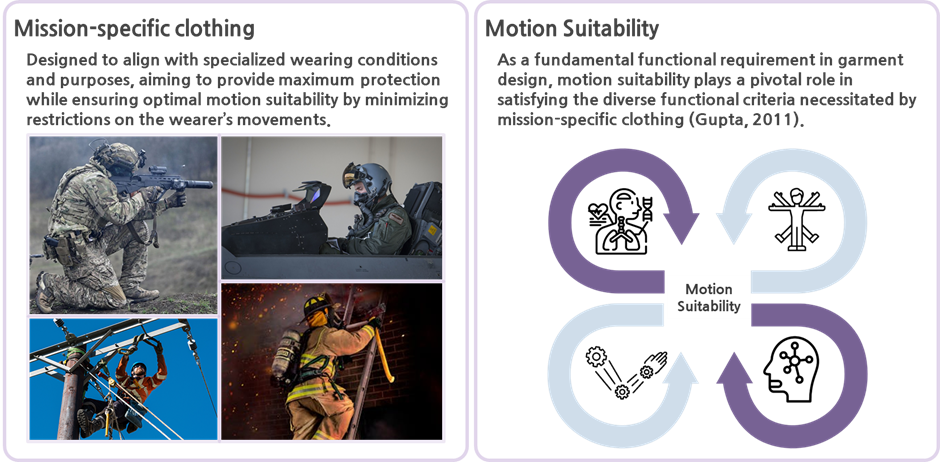
Traditionally, the development of these suits has been conducted through independent pattern designs for each case, tailored to specific mission environments and required movements. However, by analyzing the pattern design factors that influence motion suitability and establishing a systematic framework for functional pattern design based on motion levels, the efficiency of the mission-specific clothing development process can be significantly enhanced. This study developed and evaluated functional upper bodice blocks with varying design levels that can be applied universally to a wide range of mission-specific clothing. Based on these evaluations, this research presents an optimal design strategy for functional upper bodice blocks categorized by motion level to maximize motion suitability.
Theoretical Background
Unlike general clothing, garments designed with functional elements tailored to specific purposes, environments, and wearer conditions are referred to by various terms such as functional clothing, protective clothing, and specialized apparel (Gupta, 2011; Han & Nam, 2008; Scott, 2005). In this study, to develop blocks that can be universally utilized in the design of special-purpose garments, clothing designed for performing special missions or tasks in extreme environments—requiring high and rigorous functionality—is specifically termed mission-specific clothing to clearly define the scope of the research.

When designing garments with motion suitability, functional performance must be enhanced, particularly in areas where the clothing may cause a sense of restriction during active and repetitive movements (Klepser et al., 2020). The shoulder joint has the widest range of motion among all upper body joints and is directly related to arm and hand movements critical for physical activities; thus, a high level of functional mobility is required in this area during garment design (Huh & Choi, 2006). Therefore, for the upper bodice blocks that serve as the fundamental framework for mission-specific clothing, it is essential to develop functional blocks that incorporate the necessary ease for shoulder joint movements and pattern design elements for dynamic postures.
Research Methods and Procedures
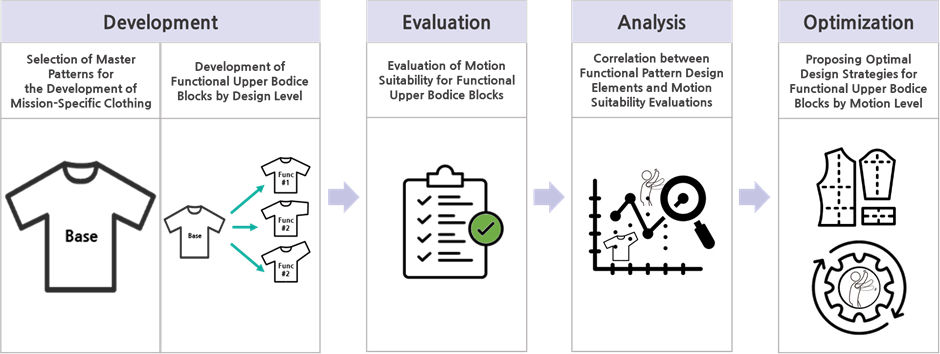
The drafting methods for the basic upper bodice patterns and functional patterns were based on previous research by Choi (2020). The functional pattern design involved four levels of sleeve angles (135°, 150°, 165°, and 180°) and four levels of underarm ease (2.5 cm, 5 cm, 7.5 cm, and 10 cm), resulting in the development of a total of 16 functional upper bodice blocks.

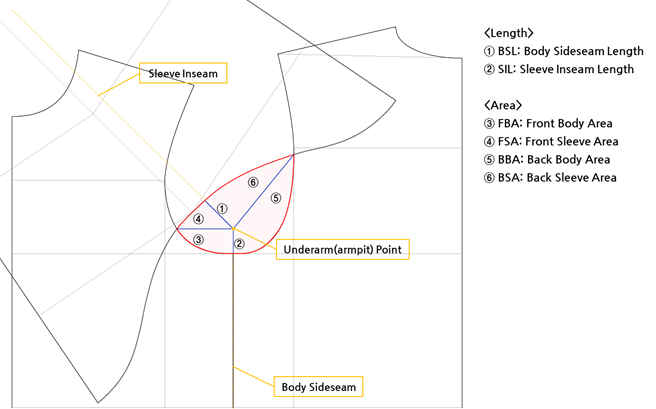
The characteristics of the functional pattern design elements formed by applying these design methods were identified and categorized into Body Sideseam Length (BSL), Sleeve Inseam Length (SIL), Front Body Area (FBA), Front Sleeve Area (FSA), Back Body Area (BBA), and Back Sleeve Area (BSA). Fifteen subjects who wear a size 100 were asked to wear 17 experimental garments—consisting of one basic pattern and 16 functional patterns—and perform major shoulder joint movements, including flexion, abduction, and horizontal adduction, to subjectively evaluate motion suitability. Furthermore, to obtain quantitative indices for evaluating the motion suitability of each experimental garment, three-dimensional body shapes were captured during various levels of shoulder joint movements. Based on body landmarks, the amount of displacement at the hem and sleeve cuffs was collected and analyzed.
Results and Discussion
The Analysis of Variance (ANOVA) on the subjective motion suitability evaluation revealed that the differences in design levels accounted for approximately 49% of the total variance, indicating statistically significant differences [F(4.50, 63.01) = 13.55, p < 0.001, n2p = 0.49]. Specifically, within the same sleeve angle level, evaluations improved as underarm ease increased. Conversely, within the same underarm ease level, higher sleeve angles were associated with lower evaluation scores. Correlation analysis between motion suitability and functional pattern design elements showed that BSA(r = 0.93) and SIL(r= 0.91) had very high positive correlations with subjective evaluations. Analysis of the correlation between the amount of displacement at the hem and sleeve cuffs during flexion and the functional pattern design elements by design level yielded several key findings. At shoulder flexion angles of 150° or less, design elements such as BSL, FBA, and BBA showed high correlations (r > 0.85) with hem displacement, while SIL and BSA were closely related (r > 0.90) to sleeve cuff displacement. For shoulder flexion movements exceeding 150°, BSL and FBA were highly correlated with hem displacement, and FBA showed a high correlation (r > 0.90) with sleeve cuff displacement. The combined results of the motion suitability evaluations indicated that the upper bodice block with a 135°-10cm design level was superior for shoulder flexion of 165° or less, while the 150°-10cm design level was most effective for flexion of 180° or more. Finally, based on the correlations between evaluation results and functional design elements, this study proposed pattern modification strategies to improve the motion suitability of functional upper bodice blocks by motion level. These strategies can be utilized in the design of mission-specific clothing that requires various levels of physical activity.
Conclusion
In this study, functional upper bodice blocks with diverse design levels were developed and evaluated for mission-specific clothing. Furthermore, by analyzing the relationship between functional pattern design elements and motion suitability, an optimal design strategy for functional upper bodice blocks categorized by motion level was proposed.
Traditionally, the development of mission-specific clothing has been characterized by discrete and fragmented processes due to the unique nature of specific tasks and environments, requiring significant time and cost for block design and development. In this regard, this study holds substantial significance by presenting a universally applicable design methodology for functional upper bodice blocks. Additionally, by developing blocks with graduated design levels, this research enables the selective adoption of functional blocks tailored to specific motion levels. Furthermore, by identifying the characteristics of functional pattern design elements that influence motion suitability and suggesting optimal design strategies based on these findings, this research is expected to provide a foundational academic and practical reference for the future development of mission-specific clothing.
References
Choi, H. E. (2020). Development of Ergonomic Jacket Patterns for the Korean Army’s Tracked Vehicle Crew, Unpublished doctor’s thesis, Seoul National University, Seoul.
Gupta, D. (2011). Design and engineering of functional clothing. Indian Journal of Fibre and Textile Research, 36(4), 327–335.
Han, S. & Nam, Y. (2008). An Exploratory Study on Domestic and International Protective Clothing Standard – Focused on ISO, ASTM, CEN, KS-. The Korean Fashion and Textile Research Journal, 10(1), 92 – 100.
Huh, J. & Choi, H. (2006). Construction of Street Cleaner Uniform for the Functional Improvement. Journal of the Korean Society of Clothing and Textiles, 30(8), 1178 – 1187.
Klepser, A., Morlock, S., Loercher, C., & Schenk, A. (2020). Functional measurements and mobility restriction (from 3D to 4D scanning). In Anthropometry, apparel sizing and design (pp. 169-199). Woodhead Publishing.
Scott, R. A. (2005). Textile for protection. Woodhead Pub. in association with the Textile Institute; CRC.
Acknowledgement
This work was supported by the Korea Research Institute for defense Technology planning and advancement(KRIT), funded by the Ministry of National Defense Republic of Korea in 2025 (23FS03).


댓글