Can We Predict the Nude Body from a Clothed 3D Scan? - A Radial Correction–Based Cross-Section Reconstruction Study Using Military Trousers -
Choi, J. Y.²,Choi, H. E.¹,²†
1 Department of Fashion and Textiles, Seoul National University, Republic of Korea
2 Research Institute of Human Ecology, Seoul National University, Republic of Korea
A Radial Correction–Based Cross-Section Reconstruction Study Using Military Trousers
As digital technologies rapidly transform the apparel industry, 3D body scanning, virtual fitting, and automated pattern systems are no longer futuristic concepts, they are becoming standard tools in garment development.
Still one fundamental question remains:
Can we accurately estimate the true human body shape from a 3D scan taken while a person is wearing clothing?
This question is not merely academic. It is critically important in the development of mission-specific garments, such as military uniforms, protective clothing, and performance wear, where mobility, safety, and equipment compatibility must all be carefully optimized.
Our recent study addresses this problem by investigating whether nude body cross-sections can be reconstructed from clothed 3D scans of standardized military trousers.
Why Is This Problem Important?
3D body scanners provide fast, non-contact, and repeatable measurements. However, once clothing is worn, several geometric distortions occur:
- Air gaps form between the body and garment.
- Fabric drape and wrinkling alter surface geometry.
- Cross-sectional shapes become asymmetrical and direction-dependent.
A common assumption might be:
“Simply subtract a fixed thickness from the outer surface to estimate the body.”
In practice, this assumption fails.
Air gaps are not uniform. They vary by anatomical region, fabric behavior, and garment structure. In mission-specific trousers, regions such as the thigh, knee, and crotch experience highly complex deformation patterns.
This leads to a key research question:
Are air-gap patterns entirely random, or do they exhibit structured, predictable characteristics under controlled conditions?
If predictable patterns exist, they can be mathematically modeled.
The Core Idea: Δr(θ)
To address this, we analyzed cross-sections in the polar coordinate domain.
For each section:
1. Inner (nude body) and outer (clothed) curves were centroid-aligned.
2. Radial distances were sampled at 1° intervals.
3. The angular radial difference was computed as:
Δr(θ) = router(θ)− rinner(θ)
This function, Δr(θ), represent air-gap thickness, surface compression, and directional expansion. Importantly, this is not a simple scalar offset. It is an angle-dependent deformation function, capturing how the garment interacts with the body in different directions.
Instead of asking, “How far apart are they?”, I ask, “In which direction does expansion occur, and by how much?”

[ Workflow of Correction Function for Reconstructing Body Curve from a Clothed Curve ]
Experimental Design
The experimental design involved ten male participants from the Republic of Korea Special Warfare Command, who were scanned in a controlled upright posture while wearing standardized military trousers (sizes 80M170–80M180) using a 3D full-body scanning system. Five horizontal cross-sections (waist, crotch, hip, thigh, and knee) were extracted, and for each section, geometric changes were quantified in terms of area ratio, circumference ratio, centroid shift, and circularity variation to systematically characterize garment-induced deformation.

[ 3D Body Scanner (SHAPENIX-405, PMT Innovation Inc., Korea) and Scan Posture ]
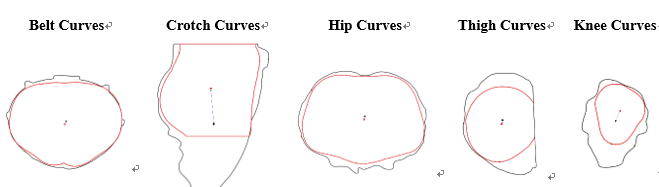
[Overlaid Inner and Outer Curves and Centroid-Shift Vectors for Each Section]
What Did We Find?
The results revealed that cross-sectional deformation increased progressively toward the lower body, with area expansion reaching approximately 12% at the belt, 16% at the hip, 38% at the thigh, and over 100% at the knee, indicating that the knee section nearly doubled in area. Importantly, this deformation was not a simple uniform radial expansion; lower-body sections exhibited decreased circularity, directional asymmetry, and localized centroid shifts, confirming structurally anisotropic garment–body interaction. Using the Δr(θ)-based correction framework, nude cross-sections were reconstructed with high accuracy (MAE ≈ 1.0 mm, RMSE ≈ 1.8 mm, MaxAE ≈ 12.6 mm), with the knee showing the most stable reconstruction and the crotch demonstrating larger localized errors due to its concave geometry, suggesting that air-gap behavior follows region-specific and geometrically consistent patterns under controlled conditions.
Why This Study Matters
This work does not claim to provide a finalized population-level prediction model. Instead, its contribution lies in establishing a measurement framework that is:
- Quantitative
- Section-specific
- Directionally interpretable
- Reproducible
1. Moving Beyond Subjective Fit Assessment
Traditional garment evaluation often relies on visual inspection, wearer feedback, circumference comparison.
This study introduces angular error mapping and nonparametric statistical validation (Kruskal–Wallis with Dunn’s post-hoc testing), enabling objective cross-sectional evaluation.
2. Enabling Virtual Evaluation for Mission-Specific Clothing
Physical wear trials for mission-specific garments are often expensive, logistically complex, physically demanding, and sometimes unsafe.
A validated reconstruction framework allows:
- Virtual fit analysis
- Air-gap behavior prediction
- Design refinement without repeated physical testing
This is particularly valuable for military, protective, and hazardous-environment apparel.
3. Foundation for Big-Data-Driven Garment Research
Future extensions may include larger and more diverse populations, multiple garment types, dynamic movement analysis (Δr(θ, t)), multi-orientation cross-sections, full 3D volumetric reconstruction.
By systematically accumulating body–garment interaction data, this approach can support:
- Data-driven size recommendation systems
- Automated pattern correction
- Simulation-based design optimization
- Digital garment twin development
This study demonstrates that under controlled conditions, clothed cross-sectional distortion is not arbitrary — it follows measurable and structured angular patterns.
By introducing a Δr(θ)-based correction framework, we establish a quantitative baseline for reconstructing nude body geometry from clothed scans.
More broadly, this research represents a shift from heuristic garment evaluation toward measurement-driven digital apparel science.
As the apparel industry continues moving toward virtual development pipelines, such structured measurement frameworks will play a central role in enabling automated virtual fit evaluation, mission-specific garment optimization, sustainable, data-driven apparel engineering.


댓글