Study on Optimal Production Construction of Military Uniforms through Analysis of Material Characteristics and Seam Strength
Park Y. H¹,Choi, H. E.¹,²†
1 Department of Fashion and Textiles, Seoul National University, Republic of Korea
2 Research Institute of Human Ecology, Seoul National University, Republic of Korea
Seams are a key element in transforming two-dimensional fabrics into three-dimensional garments. Since seam failure can directly affect the wearer's safety, seam construction is of critical importance in special mission uniforms. Considering the recent trend of incorporating stretch fabrics into the joint areas of military uniforms, this study aims to derive an optimal production construction by quantitatively evaluating the seam strength and seam elongation of military uniforms.
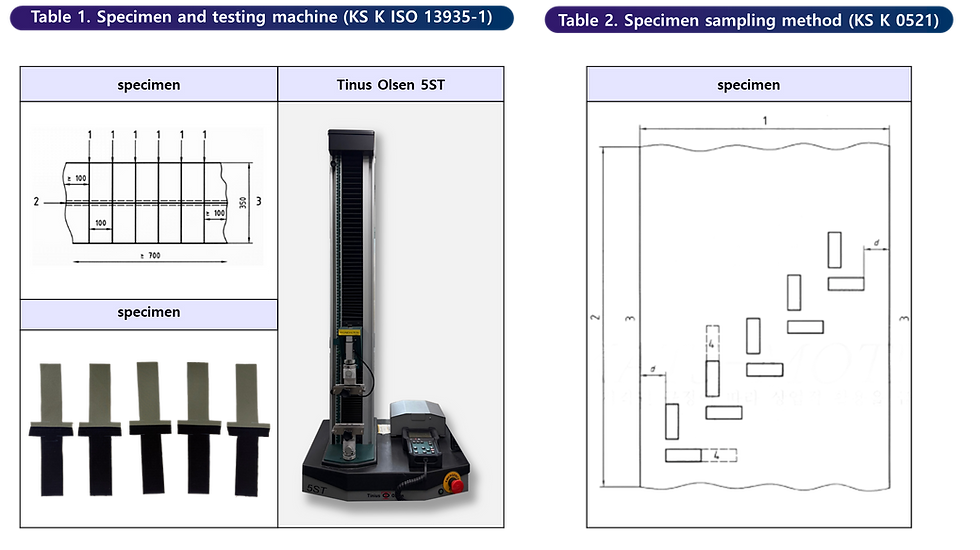
Four types of test fabrics were used: non-stretch combat fabrics (F1, F2, F3) with different grain directions and stretch fabrics (S1, S2, S3). A total of six seam types were analyzed: three non-stretch combat fabric seams and three non-stretch-to-stretch combat fabric seams. For seams composed solely of non-stretch combat fabric, specimens were arranged in warp(0°), bias(45°), and weft(90°) directions, as the bias direction exhibits higher seam elongation. Stretch fabrics were unified in the warp direction. The seam structure was set to the LSc type, which is most commonly used for combat uniform jackets (Park & Choi, 2025). Sewing was conducted using polyester spun yarn No. 50 (50/3) as specified in the National Defense Standards KS K 3601. A Brother S-7300A lockstitch (301) machine was used with 9.7 SPI and a presser foot pressure setting of 32. Specimen preparation and seam strength evaluation were performed using a Constant Rate of Extension (CRE) tester according to KS K ISO 13935-1, with a grip distance of 200±1 mm and a test speed of 100 mm/min. Mean values were calculated after five measurements, excluding the maximum and minimum values.
The results of the seam tensile test showed that seam strength was highest in the order of F3(510 N), F1(509 N), S2(466 N), F2(420.7 N), S3(400 N), and S1(386 N). Seam elongation at break followed the order of S2(50.5%), S3(39.3%), F2(37.5%), S1(36.9%), F1(28.4%), and F3(24.8%). These results are visually presented in Figure 1.

Meanwhile, in the base fabric strength test, the non-stretch combat fabric was tested in the weft(F1), bias(F2), and warp(F3) directions, while the stretch fabric was tested in both warp and weft directions, denoted as 'w' (warp) and 'f' (weft), respectively. Experimental results showed that S2-f, S3-w, and S3-f were excluded from the fabric analysis because all five specimens failed within 5 mm of the clamp edge. In the seam breaking experiment, the corresponding seams were also excluded from the data set as tearing occurred within 5 mm of the clamp, which failed to meet the "tear resistance" criteria required by military operational requirements. The fabric breaking strength results were highest in the order of S1-w(926.7 N), S2-w(920.7 N), S1-f(622 N), F1(554.7 N), F3(440.7 N), and F2(425.7 N). Seam elongation at break for the fabrics followed the order of S1-w (58.6%), S2-w(55.1%), S1-f(43.6%), F2(25.8%), F1(26%), and F3(25.8%). These results are illustrated in Figure 2.

Subsequently, based on the seam strength test results, max-value normalization was applied to eliminate unit differences between variables and facilitate comparison on a standardized scale. Each value was converted into a range between 0 and 1 by dividing it by the maximum value of the respective variable. A total score was then calculated by assigning equal weights (1:1) to each item. The calculation results showed the highest total scores in the order of F2(0.912), F1(0.878), S1(0.87), and F3 (0.831)(Figure 3).

In this study, a comparison of the seam strength and seam elongation at break between military fabrics and their seams revealed significant differences in performance. The non-stretch combat fabrics exhibited a stable trend with minimal directional deviation, while the stretch fabrics demonstrated high seam elongation under certain conditions. However, seams combining non-stretch combat fabric and stretch fabric showed a reduction in strength, which is attributed to the heterogeneity between the different materials.
Among the evaluated seams, F2 (non-stretch fabric, bias direction) demonstrated the most superior performance based on a comprehensive evaluation of seam strength, seam elongation, and fabric performance. These findings suggest that military uniform engineering must comprehensively account for both the physical properties of various materials and their seam strength. This study can serve as fundamental data for establishing production engineering standards that simultaneously consider material characteristics and seam durability.
Reference
Park, Y., & Choi, H. (2025). Analysis of seam structure characteristics and stitch types applied to combat uniform jacket. The Society of Fashion and Textiles Industry, 288.
*This work was supported by the Korea Institute for Advancement of Technology (KIAT) grant funded by the Korea Government (MOTIE) (RS-2025-02263144, The Competency Development Program for Industrial Innovation).


댓글